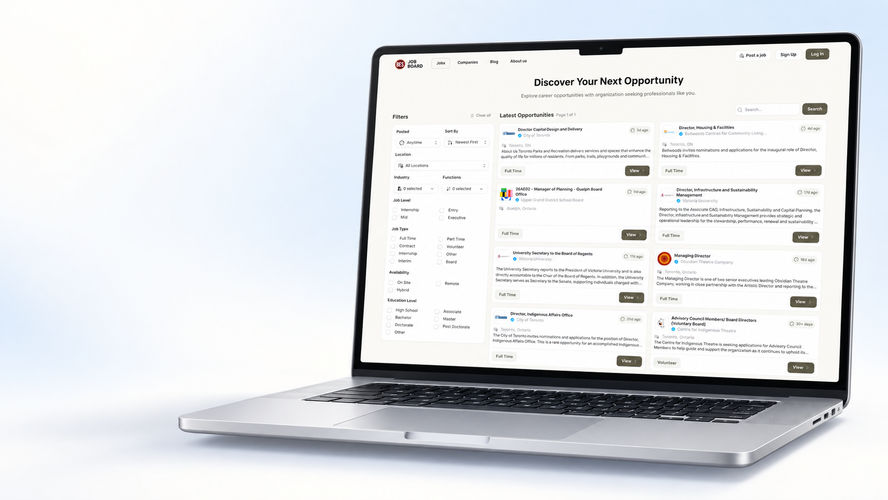
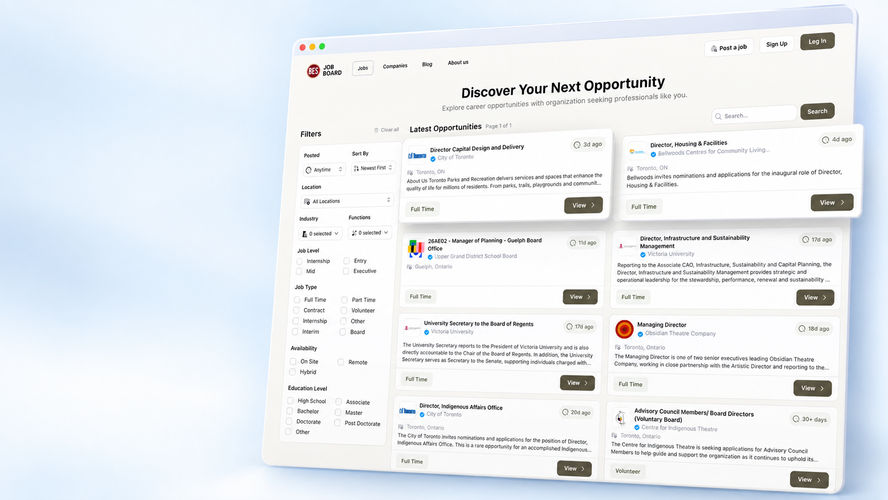
Most employers choose a job board the way they would choose a billboard: by how many people drive past it. Then the applications arrive, the shortlist looks like the last one, and the committee concludes that the market is thin. Across more than 500 executive searches, we have found the market is rarely thin. The room was wrong. This guide shows you how to choose a board by who it reaches, what it does to your posting, and what a wrong hire costs against a posting fee, whether the role is in Toronto, Ontario or anywhere in Canada.
The short answer: match the board to the role. Use a generalist board such as Indeed or the federal Job Bank for high-volume, entry-level and transferable roles, and a sector or inclusion-focused board for senior, specialized and mission-driven roles. Most employers get the strongest pool from one of each. Before you pay, check three things: who the board reaches by sector, level and city; whether it screens applicants with AI; and whether organizations like yours already post there.
Why the biggest job board for employers so often produces the same shortlist
Reach and alignment are different things. A large generalist board puts your posting in front of the most people, but the people who respond are the ones already looking there, in the way they always have. If your last three shortlists came from the same channel, the pool is not the problem. The channel is.
Here is a pattern we see from inside hiring committees. A hospital foundation posts a director of philanthropy role on the largest board it can find, receives hundreds of applications, spends weeks screening out people who have never run a campaign, and then interviews a handful of candidates who have all worked for each other. Nobody planned that outcome. The board's audience did.

1. Start with who you are missing, not how many people you can reach
Before you compare boards, name the candidate your last search did not surface. A board is only worth paying for if that person is in it. A homogeneous shortlist is a risk in itself: a committee that hears from one kind of candidate hears one kind of answer, and the posting channel is where that pattern takes hold.
When BES runs an executive search, we begin by asking the client to look beyond the networks they already know. A Toronto arts organization hiring an executive director knows the sector's usual suspects. The question is who else could do this job well and has never been told the door was open: a community organization leader, a municipal cultural planner, a producer who has carried a festival budget.
Try this before you spend a dollar:
Write down three candidate profiles you did not see last time: Sector, level, and the reason they might not have applied.
Test the board as that candidate would: Create a free account, look for roles like yours, and notice who else is posting.
Ask the board who it reaches: "Everyone" is not an answer. Sectors, levels and regions are.
Who read your last posting and decided it was not for them?

2. Choose between generalist, niche and sector boards by the role, not the budget
The right board type follows the role. A niche job board is one built for a single sector, career level or community, so its audience is smaller but more closely aligned with the role. Generalist boards suit transferable, high-volume and entry-level hiring where quantity helps. Niche and sector boards suit senior, specialized and mission-driven roles where a wrong hire is expensive and screening time is scarce. Most employers should use one of each, not one of the biggest. The order below is by fit for the reader this guide is written for: an employer posting a senior or mission-driven role in Toronto or Ontario. BES runs the BES Job Board, so weigh its place accordingly. If you are hiring in volume for hourly roles, read it from the bottom up.
Board type | Examples (posting cost, checked September 2026) | Who it reaches | Best for |
|---|---|---|---|
1. Inclusion-focused, leadership | BES Job Board: $250 CAD for 30 days | Career-focused candidates throughout Canada, including through BES's own network of 45,000+ professionals | Senior, mid-level and mission-driven roles in non-profit and public sector organizations, as well as private sector organizations |
2. Sector boards | CharityVillage: $298 + GST/HST; Work in Culture: $180 + HST | People already in the sector who treat the board as a noticeboard | Roles where sector fluency is non-negotiable |
3. Generalist boards | Job Bank: free; Indeed and LinkedIn: free basic postings, paid promotion | The widest pool of active job seekers, most outside your sector | Entry and mid-level roles with transferable skills; high-volume hiring |
Prices checked September 2026. Boards change their rates; confirm on each site before you post. For a board-by-board comparison, see the best diversity job boards in Canada.
For example, a university posting a payroll coordinator will do well on a generalist board. The same university posting a university secretary, who answers to the board of governors, is making a different decision: twenty applications from people who have sat in a governance meeting are worth more than two hundred from people who have not. Reach is also the flood. If your team cannot read everything that arrives, you are paying for volume you will never use.
3. Look at what the board does to your posting
A posting stops being your document the moment a board touches it. Some boards draft it for you, some promise to screen and match applicants, and some do nothing at all. Each choice changes who applies and what you owe applicants under Ontario law. Read the feature list as a hiring decision, not a convenience.
An AI job writer is not AI screening
The phrase "job board AI" covers two different things. An AI job writer helps you draft a clearer posting from a rough brief. AI screening uses a machine to rank, filter or reject applicants. The first saves an hour. The second is a decision about people, and since January 1, 2026, Ontario employers with 25 or more employees must disclose in the posting if they use artificial intelligence to screen, assess or select applicants. BES states on its own postings that it does not, and we hold that line for a reason: at senior levels, judgment is the job, and no model has sat in the room.
Screening and matching promises
Ask any board that promises pre-matched candidates how the match is made, what data it uses, and whether an applicant who does not fit the model ever reaches a human. If the board cannot explain it, you cannot disclose it, and you cannot defend it to a candidate who was never seen.

4. Price the posting against the cost of getting the hire wrong
A posting fee is a rounding error next to a wrong senior hire. In a Robert Half Canada survey of more than 1,800 hiring managers, 41 per cent said they had made a regrettable hire in the previous year, and the firm estimates it takes about seven weeks to let a bad hire go and another five to fill the role. The relevant comparison is not one board's price against another's; it is the price of any board against a year of salary, months of vacancy, a second search, and the team that waited through all of it. Choose the board that lowers the odds of a second search.
Run the arithmetic for your own role. Take the salary you intend to post, add the months the seat will sit empty if the first search fails and the projects that stall meanwhile, then look at the posting fee again. For illustration, consider a $120,000 director role. If the first search fails, Robert Half's estimate of roughly three months to exit and replace a wrong hire means about $30,000 of salary spent on a seat that is not delivering, before the second search starts. Against that, the difference between a free posting and a $250 one is less than one per cent. On the BES Job Board a single 30-day posting is $250 CAD; elsewhere it may be more or less, and "free" is usually paid in screening time. None of those numbers move the total. The board's audience does. Much of a wrong start is decided before day one, as we have written about what leaders inherit, and the posting channel is the first of those decisions.

5. Check the Toronto and Ontario reach before you pay for national
If the role is in Toronto, a national board is only as useful as its Toronto listings. Look at where a board's live postings are, which employers use it, and whether the candidates it attracts would move for your role. A smaller Toronto or Ontario job board with the right employers on it often outperforms a national one with none.
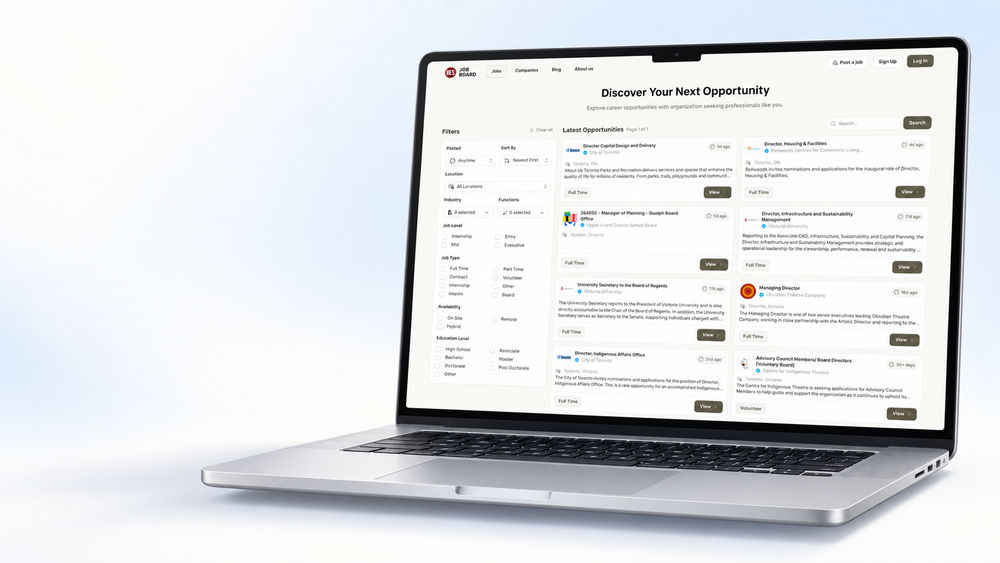
Open the live listings and filter by city and level. If the board shows three senior Ontario roles in the last month, you have learned something no sales page will tell you. Then look at the employer pages: organizations that resemble yours, posting roles like yours, are the best evidence the audience is there. As a baseline for any Canadian opening, the federal Job Bank is free, reviews each employer file and labels approved listings as verified jobs.
Check that the board supports Ontario's 2026 posting rules
Since January 1, 2026, Ontario employers with 25 or more employees have had to meet new Employment Standards Act requirements for publicly advertised job postings. That makes the board's posting form part of your compliance: if it has no field for a pay range or an AI statement, you are the one who has to remember. A public posting must now include:
Expected compensation or a range: A range may not span more than $50,000 a year. The rule does not apply where compensation, or the top of the range, exceeds $200,000 a year.
A statement on artificial intelligence: Whether the employer uses AI to screen, assess or select applicants.
A statement on whether a vacancy exists: So candidates know the posting is real.
No Canadian-experience requirement: In the posting or any application form.

Employers must also tell interviewed applicants the outcome within 45 days and keep records for three years. For the full rules, exemptions and a template, see our guide to Ontario job posting requirements. Employers with fewer than 25 employees are exempt, but we would publish the range anyway. The candidates you want read a missing range as a signal about how you negotiate.
What a good job board for employers should include
A good board for senior and mission-driven hiring gives you four things: an audience it can describe, tools that improve the posting before it goes live, a clear one-time price, and a way to reach a human when the posting is not enough. Everything else is a feature list.
What to look for | Why it matters |
|---|---|
A stated audience by sector, level and region, with live listings you can inspect | You are buying the room, not the software |
A drafting tool that keeps your judgment in the loop | The posting decides who applies before you see a resume |
No AI screening, or full disclosure, plus fields for compensation and vacancy status | Where provinces are concerned, Ontario requires it; candidates read it as honesty |
A flat, published price, editing after publishing, and a path to a search partner | Roles change, and some roles need a search |
If the role is ready, you can create a free account and post a job on the BES Job Board in a few minutes; the AI job writer is included.
Where the BES Job Board fits, and where it does not
The BES Job Board is run by BES Executive Search Inc., a Toronto executive search and EDIA (Equity, Diversity, Inclusion, and Accessibility) consulting firm founded in 2020. It is one option among the boards above, and the right one for a specific kind of hire, not every hire.
Where it fits. Senior, mid-level and mission-driven roles in non-profit and public sector organizations, as well as private sector organizations across Canada. A single 30-day posting is $250 CAD, one-time, with no subscription, and you can edit it after publishing. Postings reach BES's own network of 45,000+ professionals among others. If the posting is not enough, BES's executive search practice can be leveraged for additional support through a retained search process.
Where it does not. It is a small board. If you need hundreds of applications for hourly, retail or trades roles, or a campaign across every province, a generalist board will serve you better. It does not screen applicants for you, by design. Browse the live listings and the arts and culture category before you decide; the check in section five applies to us as much as anyone.

Common mistakes (and what they signal to candidates)
Choosing by traffic alone: Candidates cannot see your traffic numbers, but they can see who else posts on the board. A senior candidate who finds your executive role between two warehouse listings reads it differently.
Omitting the range to keep options open: To the candidate, a missing range reads as a test of who will ask. Since 2026 it is also a compliance question for most Ontario employers.
Letting a tool decide who is seen: If a screening model rejects a candidate nobody on the committee ever saw, the committee still owns the outcome. How chairs steer committees toward stronger hires begins with the posting channel.
Frequently Asked Questions
Which job board is best for employers in Canada?
There is no single best job board for employers; there is a best board for the role. Generalist boards win on volume for transferable and entry-level roles. Sector and inclusion-focused boards win on fit for senior and mission-driven roles. Test each board as a candidate would and choose the one where your target candidate is already looking.
Are niche job boards worth it compared to a large generalist board?
For senior, specialized and mission-driven roles, usually yes. A niche or sector board sends fewer applications, but a higher share come from people who can do the work, which saves screening time and lowers the odds of a second search. For high-volume or entry-level hiring, a generalist board's reach is the better buy.
What is a job board with AI, and should employers use one?
"AI" on a job board can mean a drafting tool that helps you write a clearer posting, or a screening system that ranks or rejects applicants. The first is a time saver. The second is a hiring decision that Ontario employers with 25 or more employees must now disclose in the posting. Use drafting tools freely; keep screening with people.
How much does it cost to post a job in Canada?
It ranges from free to several hundred dollars per posting, and generalist boards often charge per click. The federal Job Bank is free after an employer verification step. A single 30-day posting on the BES Job Board is $250 CAD, one-time. Price the fee against the cost of a wrong hire, not against the next board's fee.
A job board is a room, not a megaphone
Choosing a job board for employers isn't a purchase; it's a practice. Every posting is a chance to ask who was missing from the last shortlist, whether the language invites them, and whether the board you are paying for is a room they ever enter. Size will always be the easiest number to compare. It is rarely the one that decides the hire.
Ready to reach candidates outside the usual networks? Create a free account and publish a 30-day posting on the BES Job Board. The AI job writer is included, and the BES team is a call away if you want a search partner instead.

Erica Ing is Vice-President, Operations at BES Executive Search, the Toronto executive search and EDIA consulting firm. She keeps clients, candidates and the BES search team working in step, and oversees the operations and delivery that keep each search on track. Before BES, Erica worked at both a boutique and an international executive search firm. There she provided operational, client service and delivery support on searches in real estate, the public sector, academia, and leadership coaching and assessment. She holds a Bachelor of Commerce from Ryerson University.