Most employers treat Ontario job posting requirements as a legal checklist to clear before the ad goes live. In reality, the rules that took effect on January 1, 2026 describe the first screen a strong candidate runs on you: what the job pays, whether a machine reads their application, and whether the role exists. This guide reflects the rules as of September 2026, checked against the Employment Standards Act, O. Reg. 476/24 and the Ministry's guide.
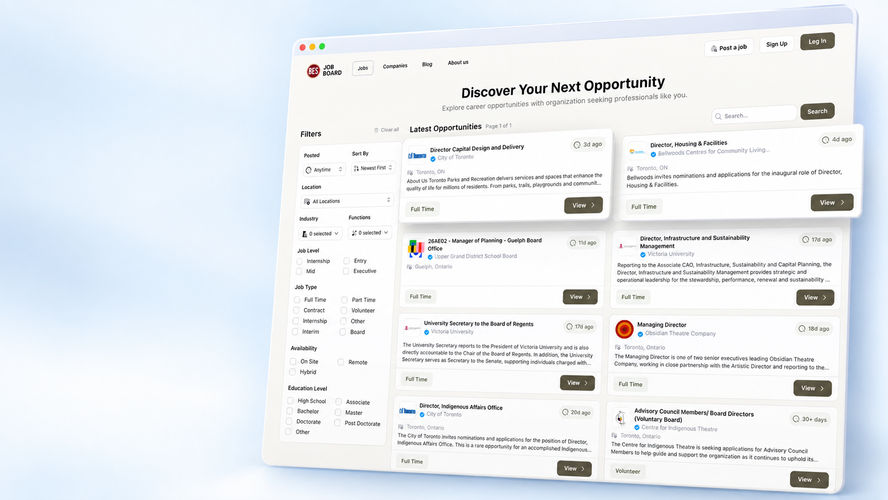
Posting the salary range? Good. Now put it where it counts. Transparent postings attract stronger applicants. Publish your Ontario posting on the BES Job Board in minutes and edit it any time. Post your job →
What Ontario job posting requirements changed on January 1, 2026
Since January 1, 2026, Ontario employers with 25 or more employees must include expected compensation, an AI disclosure and a vacancy statement in every publicly advertised job posting, must not require Canadian experience, must tell interviewed applicants the outcome within 45 days, and must keep each posting for three years. The rules sit in Part III.1 of the Employment Standards Act, 2000, added by the Working for Workers Four and Five Acts of 2024, amended by the Working for Workers Seven Act, 2025, and detailed in Ontario Regulation 476/24. Ontario's Pay Transparency Act, 2018 was never brought into force; the 2026 rules live inside the ESA.
Requirement | What the posting must do | Source |
|---|---|---|
Compensation | State expected pay or a range no wider than $50,000 a year; exempt where pay, or the top of the range, exceeds $200,000 | ESA s. 8.2; O. Reg. 476/24 ss. 3-4 |
AI disclosure | State that AI is used to screen, assess or select applicants, if it is | ESA s. 8.4 |
Vacancy statement | Say whether the posting is for an existing vacancy | ESA s. 8.5 |
Canadian experience | Do not require it in the posting or the application form | ESA s. 8.3 |
45-day notice | Tell every interviewed applicant whether a hiring decision has been made | ESA s. 8.6; O. Reg. 476/24 s. 5 |
Records | Keep every posting, every version and every application form for three years after it comes down | ESA s. 15 (7.1) |
Who must follow the rules
The threshold is 25 employees on the day the posting goes up, counted by heads across every Ontario location, according to the ontario.ca guide to the rules. Part-time staff and employees on leave each count as one, so a charity with 18 full-time and 9 part-time staff is covered. If a job board or agency posts for you, the obligation stays yours.
Who and what is exempt
Employers with fewer than 25 employees are exempt, and so are three kinds of posting: internal-only postings open to existing staff, general "we are hiring" campaigns that do not advertise a specific position, and roles performed outside Ontario. The rules also do not apply to the Crown, Crown agencies, or any authority, board, commission or corporation whose members are all appointed by the Crown. If you employ fewer than 25 people, some rules still apply; see the section on smaller employers below.

1. Salary range: publish it before you write the duties
Pay transparency is the rule candidates notice first. Ontario allows a range up to $50,000 wide and exempts roles paying more than $200,000, but the legal maximum is not a target. In our experience, a wide band tells a candidate the organization has not decided what the role is worth, and the people you most want to hear from read it exactly that way.
Compensation means wages: salary, an hourly rate, commission or a production-linked bonus must be described; discretionary bonuses, tips and most benefit-plan contributions are outside the definition. A linked document counts as part of the posting, so a range buried in a PDF still has to comply.
For example, a nonprofit board posting an executive director role at $95,000 to $145,000 is compliant and still unhelpful. Candidates at each end assume the real number is the other one. A $115,000 to $135,000 band, with the pension named, brings in the people who can take the job. Candidates skip the postings that still hide the number, and "competitive salary" is not a number.
Indeed Hiring Lab reports that the share of Ontario postings with pay information rose from 49% before the law to 71% by June 2026, and a January 2026 Employment Hero survey found 64% of Canadian job seekers had skipped a posting because it showed no salary.
Set the range from your pay band, not from the ceiling: If the band is wider than $50,000, post the portion you would offer.
Above $200,000, publish anyway: the exemption removes the obligation, not the candidate's question. Roles at that level are usually better served by a retained search than a posting.
2. AI disclosure: say whether AI touches the applicant, and what it does
If you use artificial intelligence to screen, assess or select applicants, the posting must say so. The regulation defines AI as a machine-based system that infers from inputs to generate predictions, recommendations or decisions, and the Ministry has not yet said which tools qualify, as Osler's employment group notes. For example, a college whose applicant tracking system scores résumés before a person reads them is screening with AI and must say so. A tool that drafts your ad screens no one, and a recruiter's tool counts as yours.
Indeed Hiring Lab found Ontario postings mentioning AI jumped from 9% to 28% between October 2025 and May 2026, and the Employment Hero survey found only 13% of job seekers consider AI résumé screening acceptable. At BES we state in our postings that we do not use AI to screen, assess or select applicants; the template below gives you the same sentence. If a tool does rank, say what it does and that a person decides.
3. Vacancy statement: say whether the job is real
Every covered posting must state whether it is for an existing vacancy, meaning a position that is imminently available for a qualified candidate to fill. Building a candidate pool for future openings is allowed, but the posting must say so, and the rule does not force you to fill the role. It answers a real grievance: 56% of Canadian job seekers in the Employment Hero survey believed they had applied to a ghost job. A foundation that advertises a specific program officer title "on an ongoing basis" has posted a position and needs the statement: "This posting builds a pool of candidates for anticipated openings; no vacancy currently exists."
Hiring for a nonprofit, charity or public organization in Ontario? Reach mission-driven professionals without big job board pricing. A single 30-day posting on the BES Job Board is $250 CAD. Post your Ontario role →
4. Canadian experience ban: remove it, then check the ad against the Human Rights Code
A covered posting or application form cannot require Canadian work experience, Canadian credentials or an established Canadian network; professional licensing and registration requirements remain allowed. The Ontario Human Rights Commission has treated a strict Canadian-experience requirement as discriminatory since 2013, so the ESA rule closes a gap.
The Code governs the rest of the ad. Under section 23(1), a posting infringes the right to equal treatment when it classifies applicants by a prohibited ground, directly or indirectly, according to the OHRC's advertising guidance. "Unaccented English" and a physical requirement the job does not need are the usual offenders. Inclusive hiring isn't about lowering standards; it's about correcting blind spots, and the posting is where most of them live.
Cut the wish list to what the job requires: Every extra must-have is a reason for a strong candidate to self-select out. "Has led a multi-site budget" reaches more people than "ten years in a Canadian nonprofit."
5. Accommodation statement: the AODA line most templates miss
Ontario's accessibility law asks for a line most templates leave out. Sections 22 and 23 of the Integrated Accessibility Standards require every employer to notify the public that accommodation is available for applicants with disabilities in its recruitment process, and to tell applicants selected for assessment that accommodation is available on request. A candidate who needs interview questions in advance will ask a person; they rarely ask a generic inbox.

6. 45-day notice and records: close the loop and keep the file for three years
If you interview an applicant, you must tell them whether a hiring decision has been made within 45 days of their last interview, in person, in writing, or by phone, email, text or a portal update they can reach. A call to confirm minimum qualifications is screening; a conversation that assesses suitability is an interview. Keep each notice for three years, and every version of the posting, with any linked document, for three years after it comes down.
Committees treat this as administration. Candidates treat it as character. Someone who interviewed with you and heard nothing tells their network, and in Toronto's nonprofit and public sectors that network is your next shortlist. We have written about landing the candidate once the decision is made; put the 45-day date in the committee's plan when interviews are scheduled.
What if you have fewer than 25 employees?
The six Employment Standards Act rules do not apply to you, but three things still do. The Human Rights Code governs every job ad in Ontario regardless of size, so the section 4 test still applies. The accommodation notice under the accessibility regulation applies to every employer with staff in Ontario, so section 5 does too. And the head count is taken on the day you post, so a 23-person agency hiring two coordinators can cross the line mid-year without noticing. Adopt the six rules now, while they are a choice, and you will not have to scramble when they become an obligation.
A job posting template that meets Ontario's 2026 rules
Use this job posting template as the order of the ad, not only its contents. The range and the vacancy statement sit above the duties because that is where a candidate looks first.
Title, organization, location and work arrangement (on site, hybrid, or remote within Ontario).
Vacancy statement: "This posting is for an existing vacancy."
Compensation: "$115,000 to $135,000 a year, plus a defined-benefit pension and four weeks' vacation." Name commission or a production bonus if it applies.
AI statement: "Applications are read by the hiring committee. No artificial intelligence is used to screen, assess or select applicants."
Why this role exists now: three sentences on the mandate.
What you will do: five responsibilities, each with a verb and an outcome.
What you bring: the requirements the job needs, then assets, with no Canadian-experience language.
Accommodation statement: "Accommodations are available on request at every stage of the recruitment process; contact [name] at [email]."
How to apply and what happens next: closing date, interview window, and "every interviewed candidate will hear from us within 45 days."
If the role is ready, the BES Job Board's AI job writer is built in once you create a free account and post a job.

Common mistakes (and what they signal to candidates)
Mistake | Why it fails | Fix |
|---|---|---|
A $50,000-wide band on a $90,000 role | Legal, but it reads as a negotiation you intend to win | Post the part of the band you would actually offer |
"We may use technology in our process" | Not a disclosure | Name what the tool does and say that a person decides |
A talent-pool ad with no vacancy statement | Breaks ESA s. 8.5 | "This posting builds a pool of candidates for anticipated openings; no vacancy currently exists." |
The range only in a linked PDF | A linked document is part of the posting, so it must comply too | Put the range in the body of the ad |
"Canadian experience preferred" in the application form | The ban covers application forms, not just the ad | Audit the screening questions as well as the posting |
Counting full-time equivalents instead of heads | Part-time and casual staff each count as one employee | Count heads on the day the posting goes up |
Ranges are drifting the wrong way. Indeed Hiring Lab found the median posted salary range in Ontario widened from roughly 16% to 18% between the first half of 2025 and the first half of 2026, the equivalent of a $100,000 to $116,000 posting becoming $100,000 to $118,000. Be the employer who narrowed it.
Frequently Asked Questions
Do job postings in Ontario have to include a salary range?
Yes, for most employers. Since January 1, 2026, Ontario job posting requirements under the Employment Standards Act oblige employers with 25 or more employees to state expected compensation, or a range no wider than $50,000 a year, in every publicly advertised posting, unless the pay or the top of the range exceeds $200,000.
Does the $50,000 limit mean we have to hire within the posted range?
No. The ontario.ca guide is explicit that the rule does not oblige an employer to hire at the posted level or within the posted range, and it does not prohibit an internal pay band wider than $50,000. The limit governs only what the posting shows.
What counts as artificial intelligence under the Ontario rule?
O. Reg. 476/24 defines artificial intelligence as "a machine-based system that, for explicit or implicit objectives, infers from the input it receives in order to generate outputs such as predictions, content, recommendations or decisions that can influence physical or virtual environments." The Ministry has not published a list of tools that qualify. In practice, a system that ranks, scores or filters applicants needs the disclosure; a tool that only helps you draft the ad does not screen anyone.
Do the rules apply to remote jobs?
Yes, when the work is performed in Ontario. The ontario.ca guide excludes postings for work performed entirely outside Ontario, and for work split between Ontario and elsewhere where the work outside Ontario is not a continuation of the work in Ontario. A remote role filled by someone working from home in Ottawa is covered.
Do other provinces require salary ranges in job postings?
British Columbia does, and its rule reaches further than Ontario's but sets no cap on the range. Since November 2023, every provincially regulated employer with staff in B.C., regardless of size, must include expected pay in public postings, including jobs advertised outside B.C. that a B.C. resident could fill remotely. B.C. sets no limit on how wide the range can be, according to the B.C. government. An Ontario employer hiring across both provinces should write each posting to the stricter of the two rules.
What happens if a job posting does not comply?
The Ministry of Labour, Immigration, Training and Skills Development accepts reports of non-compliant postings and enforces the rules like any other employment standard: a compliance order, a notice of contravention with a monetary penalty, or prosecution, where a corporation can be fined up to $100,000 on a first conviction, $250,000 on a second and $500,000 on a third or later, according to the ontario.ca guide. The larger cost is the candidates who never apply.
A compliant posting is the floor; a clear one is the invitation
Ontario job posting requirements give every covered employer the same six lines to write. What separates the postings that fill from the ones that sit is whether those lines were written for an auditor or for the person you hope will read them. A real range, an honest sentence about AI and a promise about when they will hear back are not compliance. They are the first thing you tell a candidate about how you lead.
Ready to hire? Your compliant posting can be live today. Create a free account in under 5 minutes, write your ad with the AI job writer, and publish a 30-day posting for $250 CAD. Post a job now →

Erica Ing is Vice-President, Operations at BES Executive Search, the Toronto executive search and EDIA consulting firm. She keeps clients, candidates and the BES search team working in step, and oversees the operations and delivery that keep each search on track. Before BES, Erica worked at both a boutique and an international executive search firm. There she provided operational, client service and delivery support on searches in real estate, the public sector, academia, and leadership coaching and assessment. She holds a Bachelor of Commerce from Ryerson University.